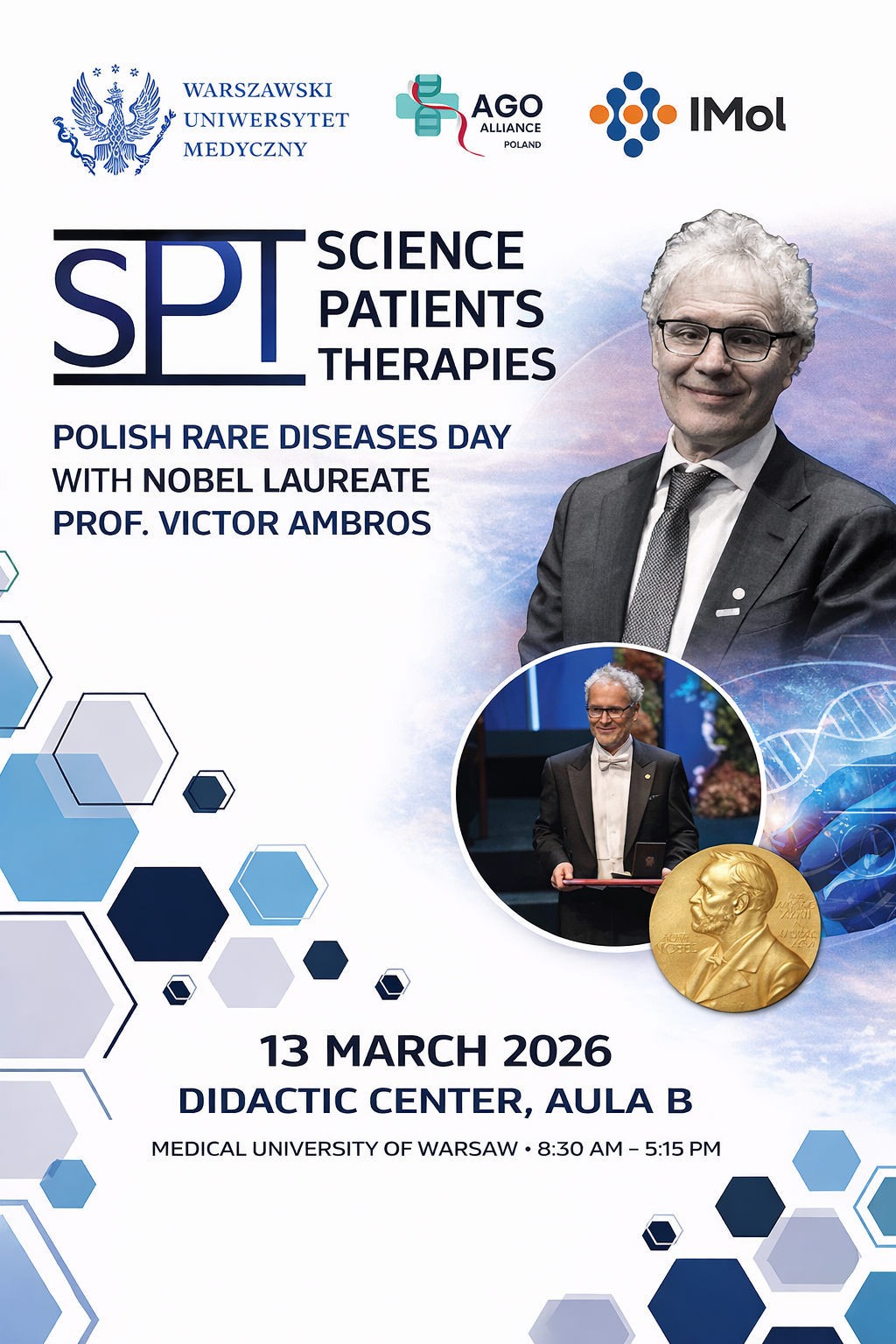
The conference “Science. Patients. Therapies.” is a nationwide, interdisciplinary event dedicated to rare diseases—from basic research, through translational medicine, to real patient access to innovative therapies. The honorary guest of the conference will be Prof. Victor Ambros, Nobel Prize laureate, discoverer of microRNA, and one of the most distinguished molecular biologists of our time. His discoveries laid the foundations for a new generation of RNA therapies (ASO, siRNA, mRNA), which today shape the direction of precision medicine.
The conference creates a space for dialogue between science, clinical practice, the healthcare system, and patient organizations, focusing on a key question: why do so many rare disease therapies fail to reach patients—and how can this be changed?
When and where:
13 March 2026; WUM Didactic Centre (ul. ks. Trojdena 2a, Warsaw), Auditorium B, 8:30–17:00
Conference participants will gain:
- the opportunity to listen to a Nobel laureate’s lecture and join an expert discussion,
- up‑to‑date knowledge about the barriers and opportunities in the development of rare disease therapies,
- insight into the perspective of patient organizations as partners in scientific research,
- the chance to exchange experiences among scientists, physicians, and patients,
- access to panel and poster sessions presenting Polish and international research initiatives,
- networking opportunities within academic, clinical, and patient communities.
Prof. Victor Ambros received the 2024 Nobel Prize in Physiology or Medicine, alongside Prof. Gary Ruvkun, for the discovery of microRNA and its role in post-transcriptional gene regulation.
The discovery of a new class of RNA molecules in 1993 fundamentally changed the understanding of gene expression control. Prof. Ambros demonstrated that microRNA regulates gene expression by determining which mRNAs are translated into proteins. MicroRNA functions as a key, previously unknown cellular “fine‑tuning” mechanism.
Today, microRNA molecules are known to play an important role in the development of many human diseases, including cancer, neurological disorders, and metabolic diseases. The discovery was made during studies on the nematode C. elegans.
Prof. Victor Ambros was born in 1953 in Hanover, New Hampshire, and is a researcher at the UMass Chan Medical School in Worcester, Massachusetts. The same institution employs Prof. Craig C. Mello—Nobel laureate and guest of WUM last year. Prof. Ambros’s father, Longin, was born in the Vilnius region and emigrated to the United States after World War II.
Since 2025, Prof. Ambros has been Chair of the Scientific Council of the International Institute of Molecular Mechanisms and Machines (IMol PAN). In March, he will visit Poland for the next meeting of this advisory body. Additionally, he serves as an ambassador for the patient‑driven research foundation AGO Alliance Poland, which develops treatment for AGO syndrome.
Besides the Nobel Prize, Prof. Ambros has received the Albert Lasker Award (2008), the Wolf Prize in Medicine (2014), and the Breakthrough Prize in Life Sciences (2015).
IMPORTANT INFORMATION FOR WUM STUDENTS AND PhD CANDIDATES:
According to Rector’s Ordinance No. 53/2026, on 13 March 2026, from 9:00 to 12:00, rector’s hours apply for WUM students and doctoral candidates attending the conference “Polish Rare Disease Day with Nobel Laureate Prof. Victor Ambros.”
Active participation is open to:
- scientists and research teams working in the field of rare diseases,
- patient organizations wishing to present their activities, research projects, or patient‑support initiatives.
Organizers:
The Medical University of Warsaw (WUM),
IMOL – International Institute of Molecular Mechanisms and Machines,
and AGO Alliance Poland.